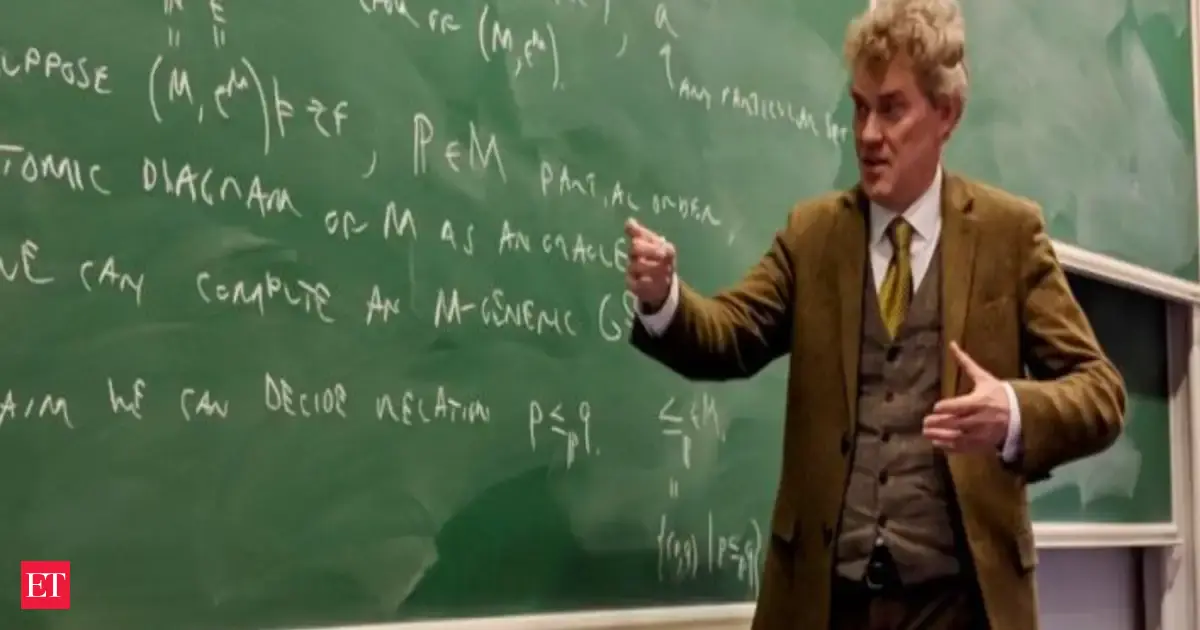
'Basically zero, garbage': Renowned mathematician Joel David Hamkins declares AI Models useless for solving math. Here's why
AI can solve a Rubik's Cube in seconds, write a sonnet about a toaster, and even convincingly argue that pineapple belongs on pizza. But ask it to prove a theorem, and suddenly it's less a supercomputer and more a highly confident hallucination generator. Joel David Hamkins' blunt assessment isn't just a slight; it's a splash of cold, hard mathematical water on the hype machine, reminding us that true understanding isn't about pattern matching, but rigorous, verifiable truth.
Hamkins' stark declaration that AI models are 'basically zero' and 'garbage' for mathematical problem-solving stems from a deep frustration with their inherent limitations. Unlike a human mathematician who builds proofs step-by-step with logical rigor, AI often fabricates solutions or provides superficially correct answers that lack foundational validity. This 'frustrating tendency to confound' – to present plausible-sounding but fundamentally incorrect or unprovable outputs – renders them useless in a field where absolute precision and verifiable truth are non-negotiable, highlighting a vast chasm between pattern recognition and genuine mathematical insight.